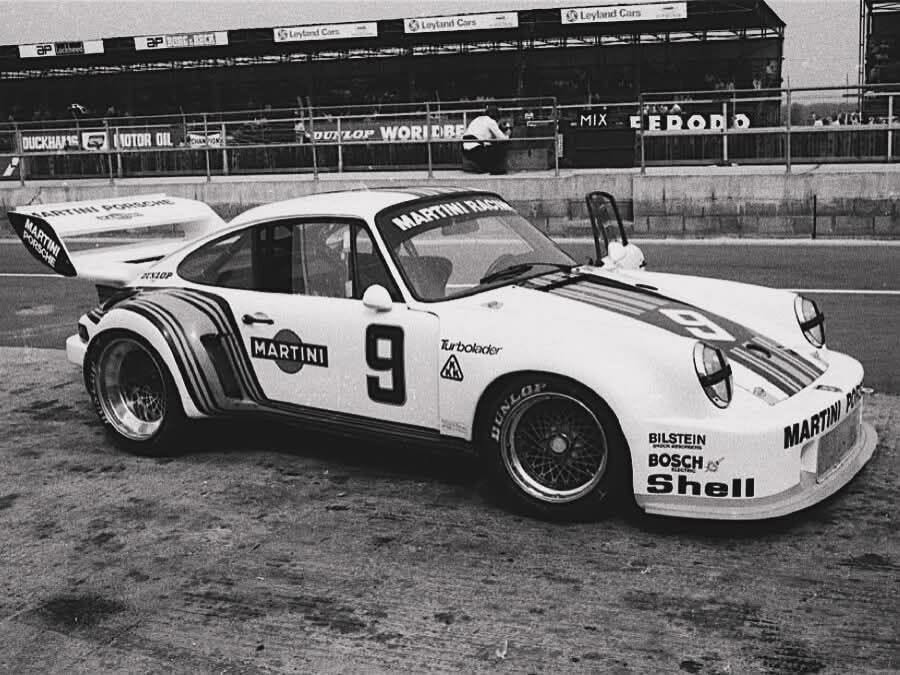
Présentée pour la saison 1976, la Porsche 935 constitue l'interprétation la plus extrême du règlement Groupe 5 par Porsche. Développée à partir de la 930 Turbo mais bénéficiant d'une liberté technique considérablement plus importante que la 934 Groupe 4, elle devient rapidement la référence absolue de l'endurance internationale et l'une des voitures de compétition les plus redoutables de son époque.
Alors que la 934 demeure relativement proche du modèle de série afin de satisfaire aux exigences du Groupe 4, la 935 exploite pleinement les possibilités du règlement « Special Production Cars ». Les ingénieurs de Weissach modifient profondément l'aérodynamique de la voiture. Les ailes sont massivement élargies, les porte-à-faux retravaillés et, dès 1977, le célèbre avant à phares intégrés surnommé « Flatnose » remplace les ailes traditionnelles de la 911 afin de réduire la traînée et d'améliorer la stabilité à haute vitesse.
Sous la carrosserie, la 935 conserve l'architecture fondamentale du Flat-6 turbocompressé de 2993 cm³ issu de la 930 Turbo. Toutefois, les possibilités de développement offertes par le Groupe 5 permettent à Porsche d'augmenter rapidement les performances. Selon les versions et les niveaux de suralimentation, la puissance dépasse largement les 600 chevaux et continue à croître au fil des saisons.
L'évolution mécanique la plus importante intervient avec l'augmentation progressive de la cylindrée. Après les premières versions de 2993 cm³, Porsche développe des moteurs de 3299 cm³ puis de cylindrées encore supérieures. Ces évolutions permettent d'améliorer à la fois la puissance maximale et la souplesse d'utilisation, tout en conservant la remarquable robustesse qui fait la réputation des mécaniques turbocompressées de Stuttgart. La version 3,3 litres devient rapidement la référence pour les programmes officiels et clients.
L'efficacité de la 935 est immédiatement démontrée en compétition. Dès sa première saison, elle domine les championnats européens et américains avant de devenir la voiture de référence des grandes courses d'endurance. Les multiples évolutions d'usine, dont les célèbres 935/77, 935/78 « Moby Dick » et les nombreuses versions développées pour les équipes clientes, lui permettent de rester compétitive pendant plusieurs années face à des prototypes pourtant beaucoup plus spécialisés.
La consécration intervient en 1979 lorsque la 935 remporte les 24 Heures du Mans au classement général. Cet exploit exceptionnel fait de la voiture la dernière Porsche dérivée de la 911 à remporter l'épreuve mancelle au scratch. Son influence sur la compétition internationale est immense et sa carrière se poursuit bien au-delà de la disparition officielle du Groupe 5 grâce aux nombreuses équipes privées qui continueront à l'exploiter durant les années 1980.
Aujourd'hui, la Porsche 935 est considérée comme l'une des voitures de course les plus emblématiques de l'histoire de Porsche. Plus qu'une simple évolution de la 930 Turbo, elle représente l'aboutissement extrême du concept 911 en compétition et demeure l'un des symboles absolus de l'âge d'or du turbo en sport automobile.
.webp)
.webp)
.webp)
.webp)
.webp)
.webp)
.webp)