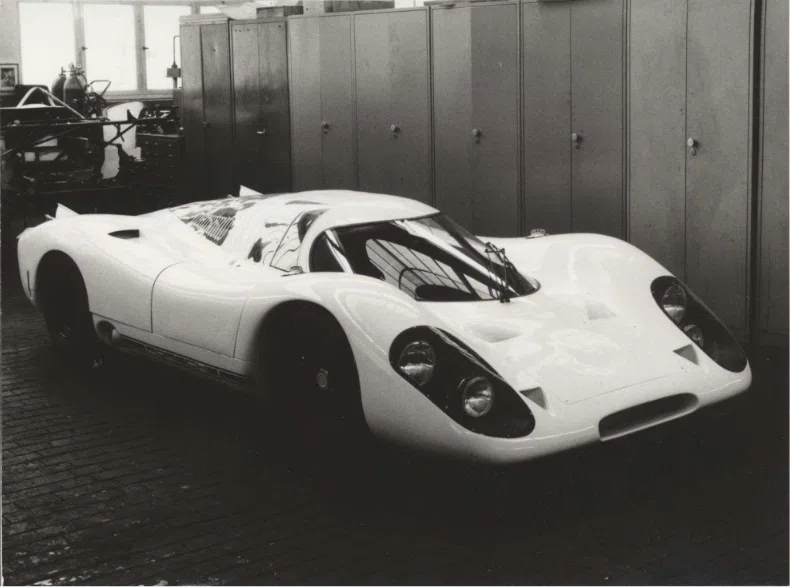
Présentée en 1969, la Porsche 917 constitue l'un des projets les plus ambitieux jamais entrepris par le constructeur de Stuttgart. Son développement est directement lié à une modification du règlement FIA du Groupe 4, qui autorise l'homologation de voitures de Grand Tourisme produites à un minimum de 25 exemplaires. Porsche saisit immédiatement cette opportunité afin de concevoir une machine capable de remporter les plus grandes épreuves d'endurance internationales.
La 917 repose sur un châssis multitubulaire en alliage léger particulièrement sophistiqué, associé à une carrosserie en matériau composite conçue pour offrir le meilleur compromis entre légèreté, rigidité et aérodynamisme. Lors de son homologation FIA n°250 en avril 1969, la voiture est équipée d'un moteur douze cylindres à plat refroidi par air de 4 494 cm³ développant 520 chevaux à 8 000 tr/min. Malgré un poids homologué de seulement 800 kg, ses performances dépassent déjà les 320 km/h sur les circuits les plus rapides. 【1-e3230d】
Les premières sorties en compétition révèlent toutefois un comportement instable à très haute vitesse. Porsche poursuit alors un important programme d'essais et de développement aérodynamique avec l'aide de ses équipes officielles ainsi que de ses partenaires de compétition. Ces travaux aboutissent rapidement à l'apparition de plusieurs variantes de carrosserie adaptées aux spécificités des différents circuits. La plus célèbre est la 917K (Kurzheck ou « queue courte »), optimisée pour les circuits sinueux et les épreuves d'endurance classiques, tandis que la 917LH (Langheck ou « queue longue ») est développée pour maximiser la vitesse de pointe sur les tracés très rapides tels que Le Mans.
Au cours de sa carrière, la 917 connaît de nombreuses évolutions mécaniques. La cylindrée d'origine de 4,5 litres est portée à 4,9 litres puis à 5,0 litres, tandis que divers perfectionnements aérodynamiques, de transmission et de refroidissement contribuent à améliorer sa fiabilité. Ces développements permettent à la voiture de devenir la référence de l'endurance mondiale au début des années 1970.
Les résultats ne tardent pas à suivre. La Porsche 917 offre à Porsche sa première victoire au classement général des 24 Heures du Mans en 1970, succès renouvelé en 1971. Elle s'impose également dans de nombreuses épreuves du Championnat du Monde des Marques et contribue à faire entrer la marque dans une nouvelle dimension sur la scène internationale.
Après sa carrière en endurance, la plateforme 917 sert de base aux spectaculaires 917/10 et 917/30 engagées dans le championnat Can-Am nord-américain. Grâce à leur puissance exceptionnelle et à leur domination sportive, ces versions prolongent la légende du modèle bien au-delà des circuits européens.
Plus d'un demi-siècle après son apparition, la Porsche 917 demeure l'une des voitures de compétition les plus emblématiques de l'histoire du sport automobile. Son design unique, ses performances révolutionnaires et son immense palmarès en ont fait un symbole durable de l'ingénierie et de l'esprit de compétition de Porsche.
.webp)
.webp)
.webp)
.webp)
.webp)
.webp)
.webp)
.webp)
.webp)
.webp)
.webp)
.webp)
.webp)
.webp)
.webp)
.webp)
.webp)
.webp)
.webp)
.webp)
.webp)
.webp)