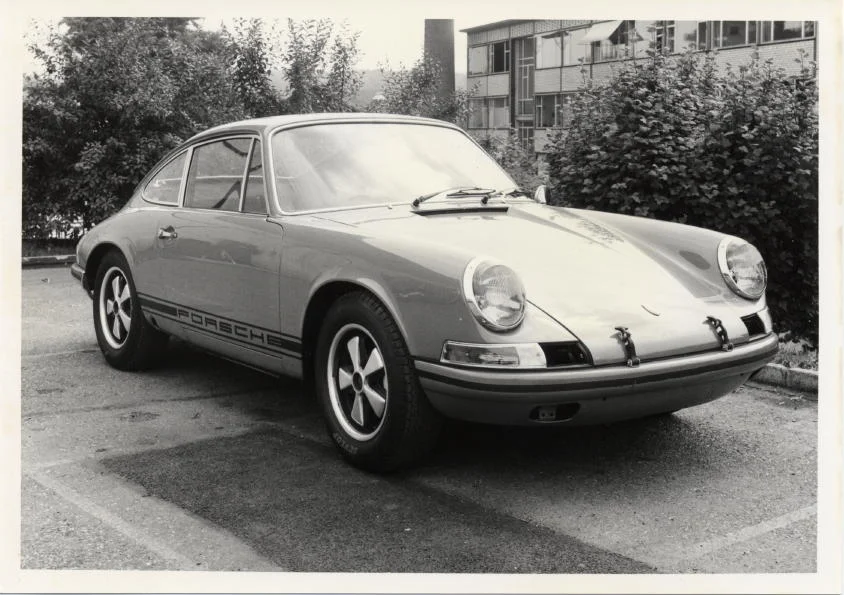
Homologuée sous la fiche FIA n°608 à compter du 1er janvier 1969, la Porsche 911 S représente alors la version la plus performante de la gamme 911 de série. Si l'évolution esthétique demeure discrète, le millésime 1969 marque une étape fondamentale dans le développement du modèle grâce à l'introduction du fameux empattement long de 2268 mm, adopté afin d'améliorer la stabilité et de rendre le comportement plus progressif à haute vitesse. Cette évolution corrige en grande partie le caractère délicat des premières 911 à empattement court et contribue à faire de la 911 S l'une des sportives les plus efficaces de sa catégorie.
Au cœur de la voiture se trouve le célèbre flat-six de 1991 cm³ refroidi par air. Doté de pistons de 80 mm et d'une course de 66 mm, il bénéficie d'un taux de compression élevé de 9,9:1 et surtout de l'injection mécanique Bosch, technologie directement inspirée des programmes de compétition de la marque. Cette pompe à six pistons en double rangée permet au moteur de développer 170 ch DIN à 6800 tr/min, une puissance remarquable pour un moteur atmosphérique de deux litres à la fin des années 1960. Associée à un poids homologué de seulement 940 kg, cette mécanique permet à la 911 S d'atteindre 225 km/h.
La conception du moteur reflète également le savoir-faire technique de Porsche. Les cylindres de type Biral combinent une chemise en fonte à des ailettes en alliage léger, tandis que la lubrification à carter sec assure une alimentation constante en huile quelles que soient les conditions d'utilisation. Le refroidissement est confié à une turbine à onze pales associée à deux radiateurs d'huile, une configuration pensée pour supporter un usage sportif intensif.
Le châssis repose sur une suspension indépendante aux quatre roues utilisant des barres de torsion et des amortisseurs hydrauliques double effet. Le freinage est assuré par quatre disques ventilés commandés par un système hydraulique à double circuit, une solution avancée pour l'époque qui contribue à la réputation de robustesse et d'endurance de la voiture.
Les extensions d'homologation révèlent également le potentiel sportif du modèle. Dès 1969 apparaissent des bielles en titane allégées destinées à un usage compétition, tandis que l'homologation Groupe 4 de 1970 introduit des éléments de carrosserie en plastique, des vitrages en Plexiglas, des culasses à double allumage, des élargisseurs d'ailes et diverses mesures d'allègement. Ces évolutions serviront de base aux futures 911 de compétition qui domineront de nombreuses catégories de course au début des années 1970.
Souvent considérée comme l'une des plus pures représentantes de la première génération de 911, la 911 S 2.0 combine légèreté, sophistication mécanique et héritage sportif. Elle constitue aujourd'hui un maillon essentiel dans l'évolution des Porsche de route comme des Porsche de compétition.
.webp)
.webp)
.webp)
.webp)
.webp)