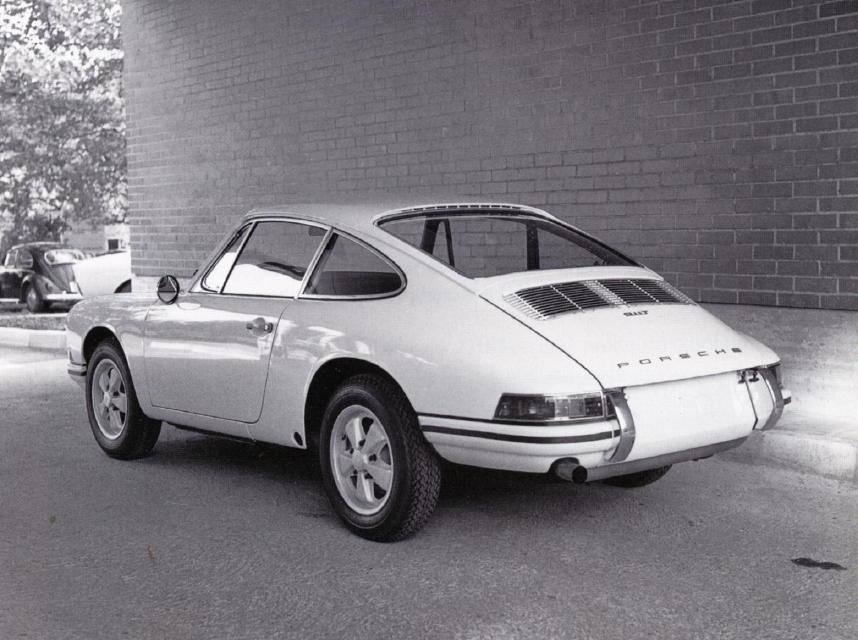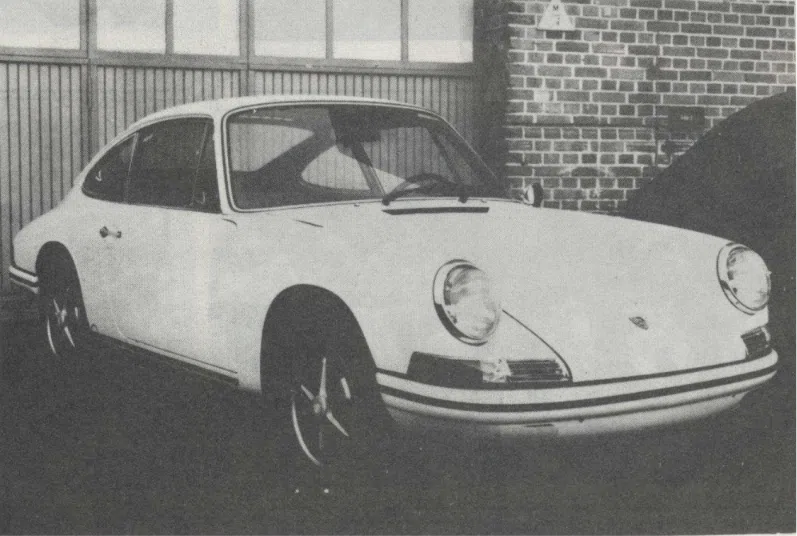
Homologuée sous la fiche FIA n°577 fin novembre 1967 pour une validité en Groupe 3 (Grand Tourisme) au 1er janvier 1968, la 911 T pose des jalons cruciaux pour la compétition client de l'époque. Sa mécanique de série développe 110 ch DIN à 5800 tr/min (avec un taux de compression de 8,6:1) via un flat-6 refroidi par air doté d'une soufflante à 11 pales d'environ 25 cm de diamètre. L'architecture fondamentale de ce bloc 4 temps intègre une lubrification par carter sec avec un circuit d'huile d'environ 10 litres, des culasses en alliage léger, et des cylindres combinant fonte grise, Biral ou alliage léger chromé dur. L'admission du mélange est confiée à une paire de carburateurs triple corps à flux descendant Weber (modèles 40 IDT 3 C ou 40 IDS 3 C). La transmission aux roues arrière s'effectue via un embrayage monodisque à sec de 216 mm de diamètre couplé à une boîte de vitesses mécanique à 4 ou 5 rapports synchronisés (la transmission automatique Sportomatic était également homologuée).
Le châssis monocoque en tôle d'acier permet au véhicule d'afficher un poids particulièrement avantageux de 923 kg, une pesée officielle DIN 70020 réalisée avec les pleins d'huile et d'eau ainsi que la roue de secours, mais à sec de carburant. La suspension indépendante, recourant à des jambes de force à l'avant et des bras tirés obliques à l'arrière, repose de série sur des barres de torsion de 22 mm, avec des options d'usine permettant de passer à 23 mm. Le freinage est assuré par un système hydraulique à double circuit pinçant des disques de 282 mm de diamètre à l'avant et de 285 mm à l'arrière.
La métamorphose sportive de ce châssis (qui donnera notamment naissance aux fameuses versions spéciales pour la course) est documentée en détail dans la section des équipements de sport spéciaux (*Sportausrüstung*) de la fiche d'homologation. On y trouve un imposant réservoir de sécurité de 100 litres, de massives plaques de protection sous le moteur et le train avant, ainsi qu'une vaste sélection de pignons de boîte de vitesses additionnels pour adapter l'étagement à chaque circuit. Pour passer la puissance au sol et accroître l'adhérence en virage, l'usine homologue des jantes Fuchs en alliage léger forgé de 6 pouces de large à l'avant et 7 pouces à l'arrière. Ce montage asymétrique, qui repousse les voies à 1379 mm et 1365 mm, nécessite l'utilisation de lourdes entretoises de 27 mm à l'arrière et justifie le repliage officiel des rebords intérieurs d'ailes (*Radlaufborde umgelegt*) de la carrosserie.
.webp)
.webp)
.webp)
.webp)
.webp)
.webp)
.webp)
.webp)
.webp)
.webp)
.webp)
.webp)
.webp)
.webp)
.webp)
.webp)
.webp)