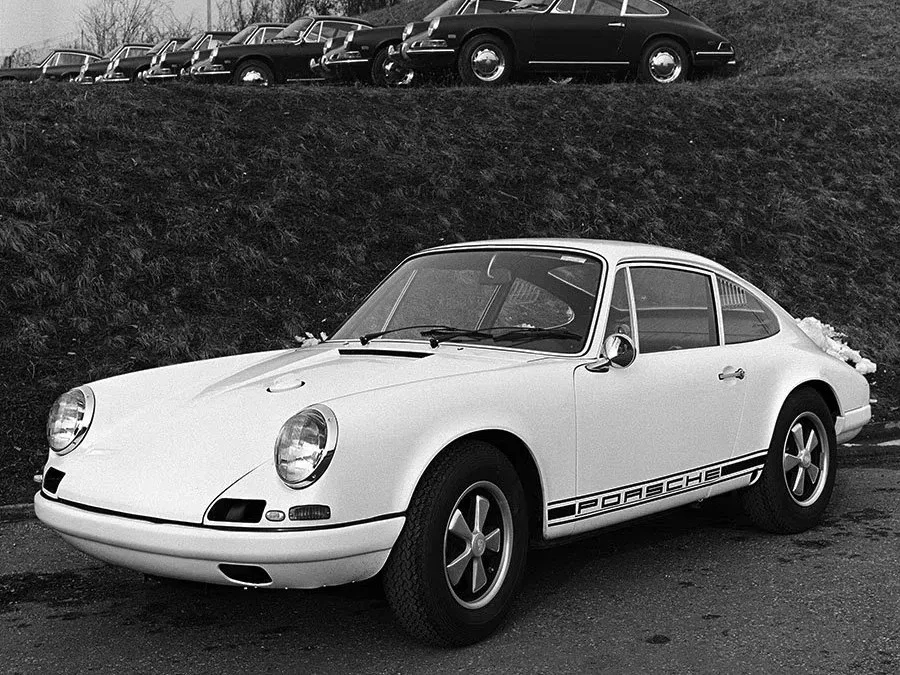
Née de la volonté de battre des records d'endurance à Monza après l'échec des suspensions d'une 906 préparée, la 911 R (pour Rennen) devient l'arme expérimentale absolue de l'usine. N'ayant jamais atteint les 500 exemplaires requis pour une homologation en Groupe 3 (Grand Tourisme), sa carrière officielle se limitera à la catégorie Prototype. Sous le capot arrière s'abrite le bloc Type 901/22 en aluminium, directement hérité de la Carrera 6. Affichant un taux de compression de 10.3:1, il déploie une puissance foudroyante de 210 ch DIN à 8000 tr/min (soit un rendement exceptionnel de plus de 105 ch/litre) pour un couple de 206 Nm à 6000 tr/min. L'équipage mobile est digne de l'aéronautique de l'époque : vilebrequin forgé reposant sur 8 paliers, bielles en titane, cylindres à chemises chromées et volant moteur allégé couplé à un embrayage monodisque renforcé. La culasse, dotée d'un double allumage (deux bougies par cylindre), abrite une distribution à simple arbre à cames en tête.
L'ingénierie du châssis repose sur une chasse impitoyable aux masses. La coque en acier autoporteuse est habillée par le carrossier Karl Baur avec des éléments de carrosserie en fibre de verre et plastique (ailes avant, capots, pare-chocs, portières), articulés par des charnières en aluminium. La cure d'amincissement va jusqu'à l'emploi d'un pare-brise de 4 mm et d'un vitrage en plexiglass de 2 mm. L'habitacle est vidé de toute garniture superflue, supprimant même les dossiers arrière, pour abaisser le poids à 800 kg à sec. L'encombrement global s'établit à 4163 mm de long, 1610 mm de large pour une hauteur rabaissée à 1280 mm. Pour passer cette cavalerie au sol via des pneumatiques HR 15 (en 165 ou 185 selon les montes), les voies sont élargies et la suspension adopte des barres de torsion raffermies, atteignant 22 mm de diamètre à l'arrière. L'endurance est assurée par un imposant réservoir de carburant de 100 litres logé à l'avant et un réservoir d'huile spécifique en aluminium.
La rareté du modèle s'établit à seulement 24 exemplaires (4 prototypes usine et 20 unités clients assemblées par Baur). Son heure de gloire résonne sur l'anneau de Monza en 1967 où une équipe suisse pulvérise les records mondiaux de distance, avalant 20 000 km à 209,24 km/h de moyenne (ainsi que les records des 72h, 96h et 10 000 miles). Ce tour de force de fiabilité a été rendu possible par une astuce sur la transmission à propulsion : le pignon de 5ème rapport étant le seul véritablement martyrisé sur cet anneau de vitesse, les ingénieurs ont préventivement monté deux pignons identiques sur les 4ème et 5ème rapports. Le bloc subira même 100 heures de test au banc après cette épreuve destructrice, sans nécessiter la moindre intervention. Capable de pointer à 245 km/h et d'abattre le 0 à 100 km/h en 6,1 secondes, la 911 R validera également ses acquis dynamiques sur route, notamment avec les victoires retentissantes de Gérard Larrousse au Tour de France Automobile en 1969.
.webp)
.webp)
.webp)
.webp)
.webp)
.webp)
.webp)
.webp)