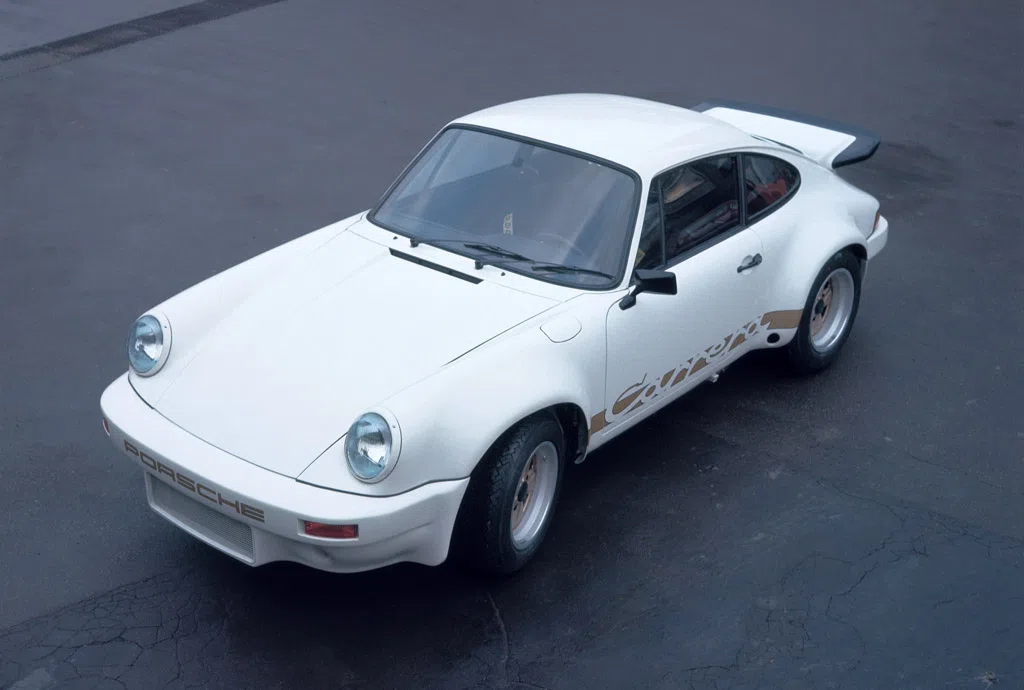
Présentée pour le millésime 1974, la Porsche Carrera RS 3.0 représente l'ultime évolution atmosphérique des premières 911 Carrera développées pour satisfaire aux exigences de l'homologation Groupe 4. Succédant à la célèbre Carrera RS 2.7 de 1973, elle est conçue comme une série limitée destinée à servir de base à la redoutable Carrera 3.0 RSR engagée en compétition internationale.
Par rapport à la RS 2.7, la nouvelle version bénéficie d'améliorations substantielles. Son moteur six cylindres à plat refroidi par air voit sa cylindrée portée à 2992 cm³ grâce à un alésage accru de 95 mm. Alimenté par l'injection mécanique Bosch, il développe 230 chevaux à 6200 tr/min tout en conservant la souplesse et la fiabilité qui ont largement contribué à la réputation des moteurs Porsche de compétition.
La carrosserie adopte les ailes élargies caractéristiques de la RSR afin d'accueillir des voies plus larges et des pneumatiques plus généreux. La structure allégée conserve plusieurs éléments en fibre de verre, notamment le couvercle de coffre avant, tandis que le freinage est considérablement renforcé grâce à l'adoption de disques de plus grand diamètre et d'étriers dérivés de l'expérience acquise en compétition.
Produite en quantité limitée, la Carrera RS 3.0 est avant tout destinée à permettre l'homologation de la future 3.0 RSR en Groupe 4. Cette étroite parenté technique explique pourquoi la RS 3.0 est souvent considérée comme la version routière la plus proche d'une véritable voiture de course parmi les 911 de son époque.
La Carrera RS 3.0 occupe aujourd'hui une place particulière dans l'histoire de Porsche. Plus rare que la RS 2.7 et directement liée aux succès des RSR en endurance, elle constitue le dernier développement majeur des 911 atmosphériques de compétition-client avant l'arrivée des modèles turbocompressés de la seconde moitié des années 1970. Son équilibre entre légèreté, performances et efficacité en fait l'une des variantes les plus recherchées de la première génération de 911.
.webp)
.webp)
.webp)
.webp)
.webp)
.webp)
.webp)
.webp)
.webp)
.webp)
.webp)
.webp)
.webp)
.webp)
.webp)
.webp)
.webp)
.webp)
.webp)