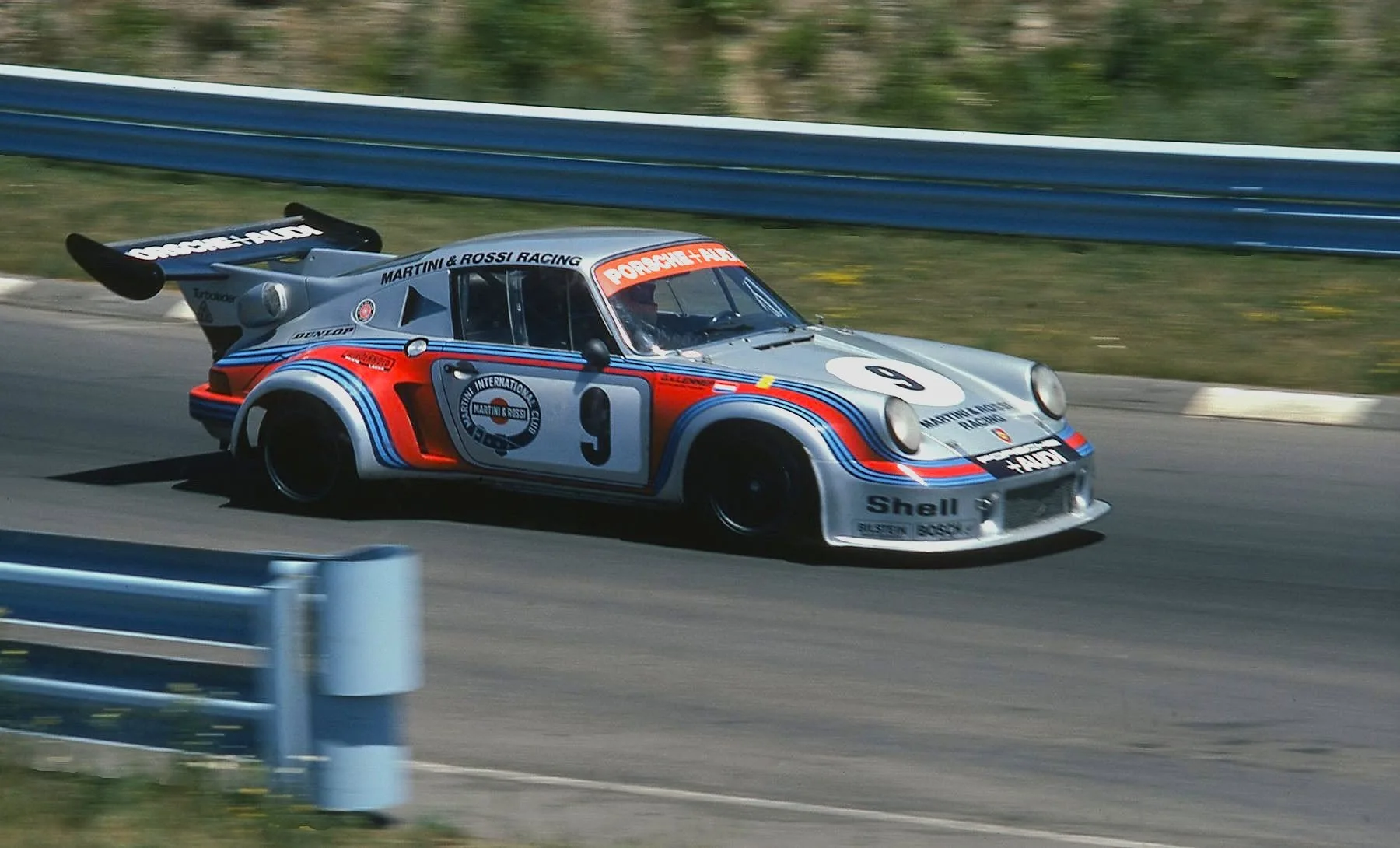
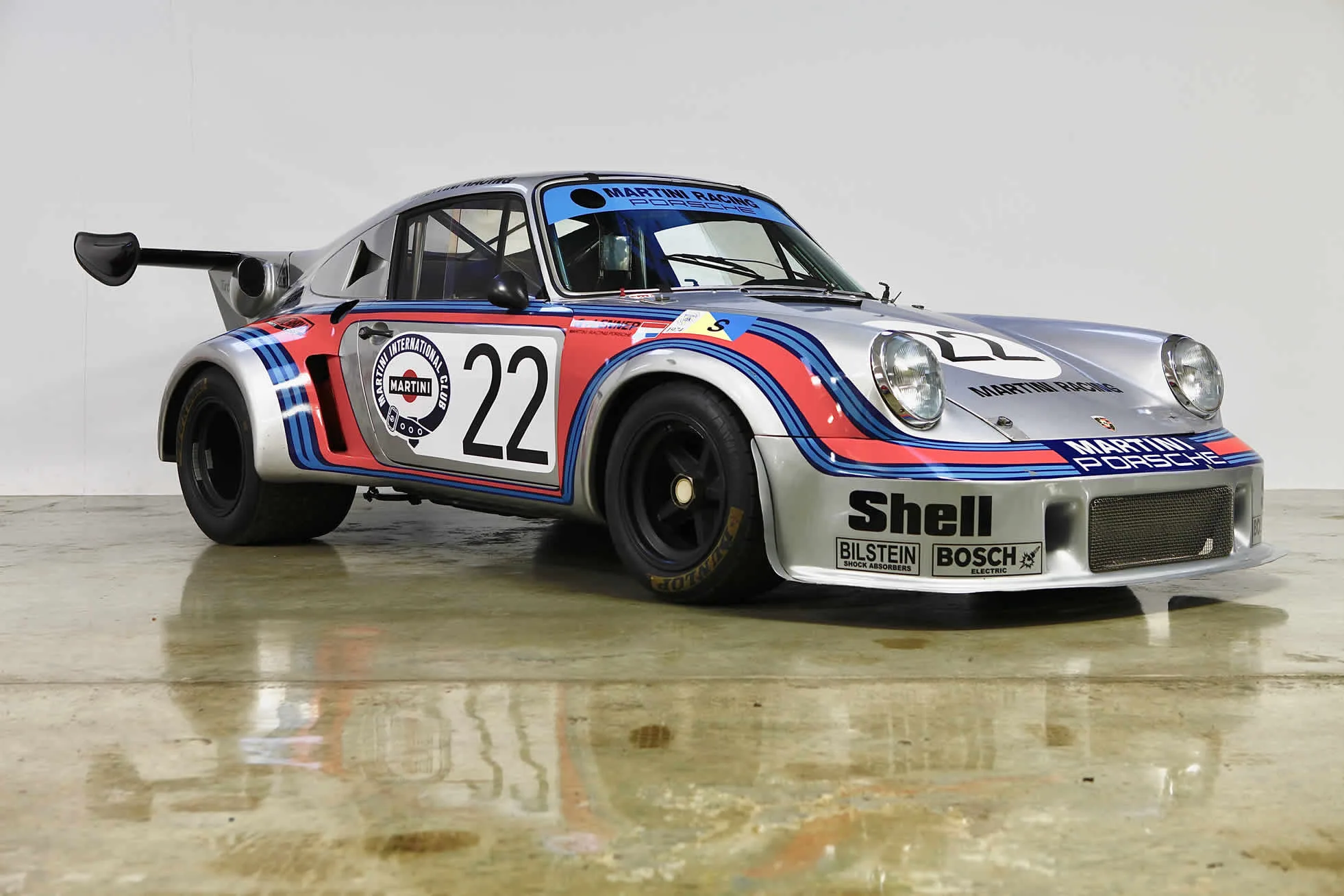
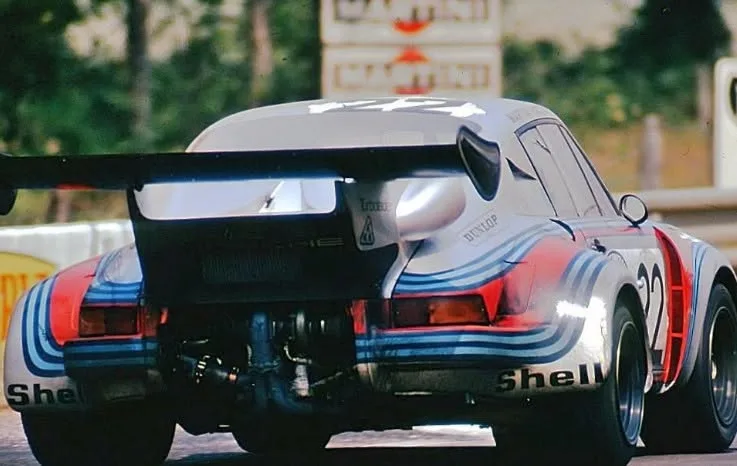
Portant le numéro de châssis 9114609102 (nom de code interne R13), cette exceptionnelle 911 RSR Turbo est sans conteste la plus titrée et célèbre des quatre voitures d'usine développées pour la saison 1974. Repoussant les limites réglementaires avec son moteur Flat-6 de 2,1 litres (2143 cm³) turbocompressé développant 500 chevaux, elle évolue dans la redoutable catégorie Groupe 5 (Prototype 3.0L). Parée de la légendaire livrée Silver Martini, son poids plume de 750 kilos en fait une véritable arme sur la piste.
Ce châssis débute sa carrière en trombe lors du monument de l'endurance : les 24 Heures du Mans 1974. Confiée au duo phare de l'usine, Herbert Müller et Gijs van Lennep (arborant le numéro 22), la R13 démontre une extraordinaire combativité face à l'armada Matra. Surmontant d'importants problèmes de boîte de vitesses et de direction l'obligeant à terminer l'épreuve avec seulement deux rapports fonctionnels (la 4ème et la 5ème), elle livre un duel homérique et franchit la ligne à une éblouissante 2ème place du classement général.
Propulsée en pointe de l'attaque Porsche, la R13 enchaîne ensuite avec les 6 Heures de Watkins Glen. Malgré des débuts chaotiques (perte de la section arrière et des roues pendant le transport), l'équipage Müller/van Lennep arrache une nouvelle 2ème place absolue. La suite de la saison, rythmée par les 1000 Kilomètres du Paul Ricard (7ème place) et de Brands Hatch (5ème place), est marquée par de persistants problèmes de boîte de vitesses et une aérodynamique capricieuse (la perte du spoiler avant à Brands Hatch provoquant des levées de l'essieu avant à plus de 190 km/h). Malgré ces défis, la R13 achève la saison 1974 avec un taux de réussite insolent : 100% de ses courses terminées aux avant-postes.
En 1975, Porsche cède ce joyau historique à Vasek Polak qui l'intègre à son illustre collection d'Hermosa Beach, en Californie. Sortie de sa retraite sportive, la voiture est louée à deux reprises pour des épreuves IMSA américaines en 1977. Sous l'égide de l'Interscope Racing, elle dispute les 24 Heures de Daytona (la célèbre livrée Martini étant alors dissimulée sous un film de protection), abandonnant sur casse moteur. Elle effectue son ultime tour de piste officiel aux 3 Heures de Mid-Ohio (26ème) louée par George Follmer.
Restituée à Vasek Polak, elle y restera méticuleusement préservée jusqu'en 1998, date à laquelle elle entre dans une série de grandes collections privées (Jeff Lewis, Greg Galdi, John Kotts, puis Carlos Monteverde en 2010). Bénéficiant d'une restauration intégrale de la plus haute qualité par les spécialistes britanniques Maxted-Page, cette icône absolue du sport automobile a magnifié de sa présence les plus grands événements de la planète (Rennsport Reunion, Goodwood, Amelia Island), participant même à un récent trackday à Goodwood en juillet 2024.
Bearing chassis number 9114609102 (internal codename R13), this exceptional 911 RSR Turbo is indisputably the most successful and famous of the four factory cars developed for the 1974 season. Pushing the boundaries of the regulations with its 2.1-liter (2,143 cc) turbocharged flat-six engine—producing 500 horsepower—it competed in the formidable Group 5 (3.0L Prototype) category. Adorned in the legendary silver Martini livery, its featherweight 750-kilogram build made it a true weapon on the track.
This chassis began its career with a spectacular performance at an endurance racing landmark: the 1974 24 Hours of Le Mans. Entrusted to the factory’s star duo, Herbert Müller and Gijs van Lennep (carrying race number 22), the R13 demonstrated extraordinary fighting spirit against the Matra armada. Despite overcoming significant gearbox and steering issues—which forced the car to finish the race with only two functional gears (4th and 5th)—it engaged in an epic duel and crossed the finish line in a stunning 2nd place overall.
Spearheading Porsche’s assault, the R13 went on to compete in the 6 Hours of Watkins Glen. Despite a chaotic start—including the loss of the rear bodywork and wheels during transport—the driver pairing of Müller and van Lennep managed to secure another 2nd-place overall finish. The remainder of the season—highlighted by the 1000 Kilometres of Paul Ricard (7th place) and Brands Hatch (5th place)—was plagued by persistent gearbox issues and temperamental aerodynamics (the loss of the front spoiler at Brands Hatch caused the front axle to lift at speeds exceeding 190 km/h). Despite these challenges, the R13 concluded the 1974 season with an extraordinary success rate: it finished every race it entered at the front of the field.
In 1975, Porsche sold this historic gem to Vasek Polak, who added it to his renowned collection in Hermosa Beach, California. Brought out of its racing retirement, the car was leased on two occasions for American IMSA events in 1977. Entered by Interscope Racing, it competed in the 24 Hours of Daytona—with its iconic Martini livery concealed beneath a protective film—but was forced to retire due to an engine failure. It made its final official track appearance at the 3 Hours of Mid-Ohio (finishing 26th), having been leased by George Follmer.
Returned to Vasek Polak, the car was meticulously preserved until 1998, when it began a journey through a succession of major private collections (including those of Jeff Lewis, Greg Galdi, and John Kotts, before being acquired by Carlos Monteverde in 2010). Following a comprehensive, top-tier restoration by the British specialists at Maxted-Page, this absolute icon of motorsport has graced some of the world’s most prestigious events—such as the Rennsport Reunion, the Goodwood Festival of Speed, and the Amelia Island Concours d’Elegance—most recently participating in a track day at Goodwood in July 2024.
.webp)
.webp)
.webp)
.webp)
.webp)
.webp)
.webp)
.webp)
.webp)
.webp)
.webp)
.webp)
.webp)
.webp)
.webp)
.webp)
.webp)
.webp)
.webp)
.webp)
.webp)
.webp)
.webp)
.webp)
.webp)