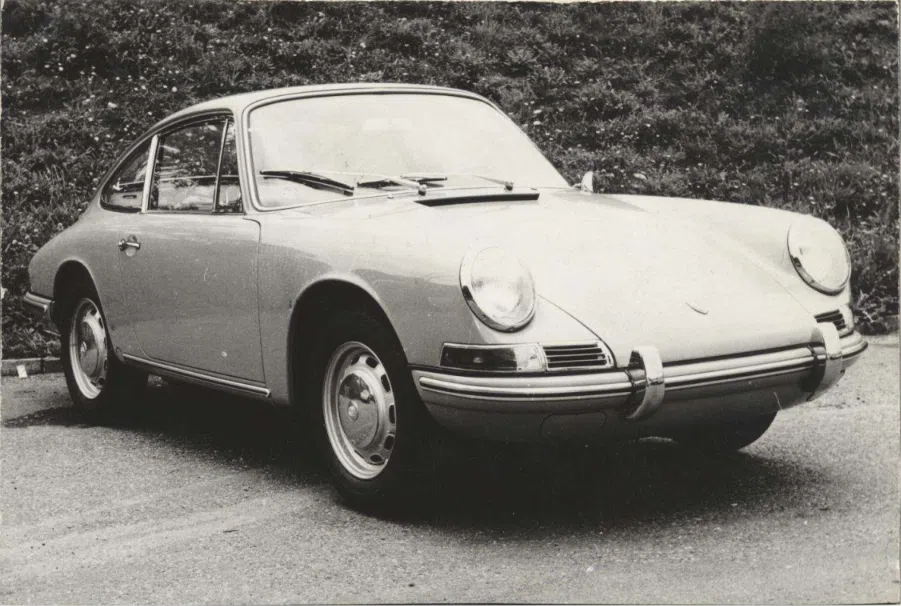
Homologuée par la FIA dès le 16 novembre 1964 sous le numéro 183 en catégorie Grand Tourisme, la Porsche 911 marque le commencement d'une lignée appelée à devenir l'une des plus victorieuses de l'histoire du sport automobile. Succédant à la Porsche 356, elle conserve le principe du moteur placé en porte-à-faux arrière tout en adoptant une conception entièrement nouvelle, plus puissante, plus moderne et plus ambitieuse. Dès sa présentation, la 911 se distingue par sa carrosserie autoporteuse dessinée par Ferdinand Alexander Porsche et par son inédit moteur six cylindres à plat refroidi par air.
Le moteur type 901 développe 130 ch DIN à 6100 tr/min pour une cylindrée de 1991 cm³ obtenue grâce à un alésage de 80 mm et une course de 66 mm. Alimenté par six carburateurs Solex 40 PI, il repose sur une architecture particulièrement sophistiquée pour l'époque : deux arbres à cames en tête entraînés par chaînes, lubrification à carter sec et culasses en alliage léger. Associé à une boîte manuelle Porsche type 901 à cinq rapports synchronisés, cet ensemble permet déjà à la jeune 911 de rivaliser avec des voitures de cylindrée supérieure. 【1-64f87f】
Le châssis court de première génération, doté d'un empattement de 2211 mm, confère à la voiture une grande agilité mais également un tempérament particulièrement exigeant à la limite. Les quatre roues sont indépendantes, avec barres de torsion longitudinales et amortisseurs hydrauliques double effet. Le freinage, confié à un système Ate/Porsche à quatre disques, constitue alors une solution avancée qui contribue largement aux qualités sportives du modèle. Avec un poids homologué FIA limité à 1002 kg sans carburant, la 911 affiche un excellent rapport poids/puissance pour son époque.
Dès ses premières saisons en compétition, Porsche développe une série d'évolutions destinées à l'endurance et aux rallyes. Les extensions d'homologation introduites en 1965 permettent notamment l'installation d'un réservoir de 100 litres, de protections inférieures du châssis, de jantes plus larges et de barres stabilisatrices renforcées. Une évolution spécifique introduit également des modifications de boîte de vitesses, un système de refroidissement amélioré des freins avant ainsi qu'une version export équipée de collecteurs d'échappement simplifiés remplaçant les échangeurs thermiques d'origine.
Plus qu'un simple nouveau modèle, la première 911 à châssis court pose les bases techniques et philosophiques de toutes les générations qui suivront. Son moteur six cylindres à plat, son architecture arrière et son extraordinaire potentiel d'évolution permettront à la 911 de s'imposer progressivement dans les épreuves de Grand Tourisme, avant de devenir l'une des références absolues du sport automobile international.
.webp)
.webp)
.webp)
.webp)
.webp)
.webp)
.webp)
.webp)
.webp)
.webp)
.webp)
.webp)
.webp)
.webp)
.webp)
.webp)
.webp)
.webp)
.webp)
.webp)