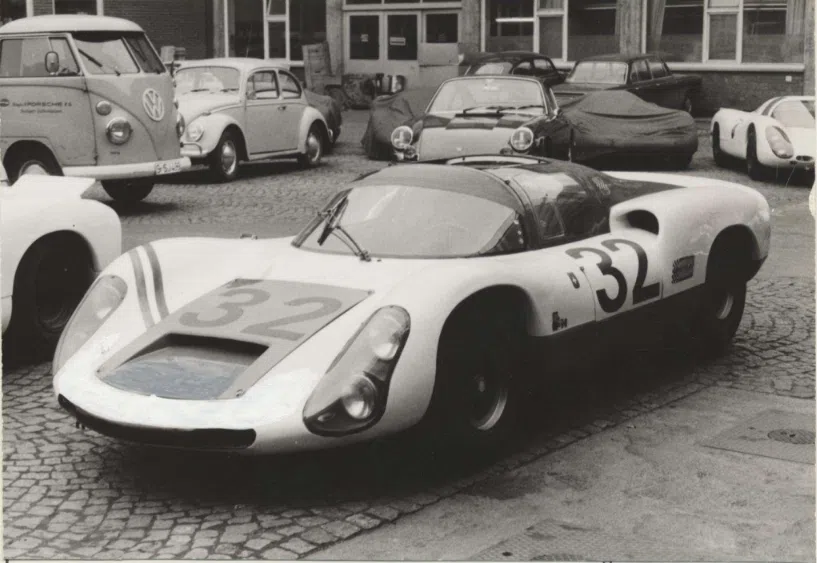
Présentée pour la saison 1967, la Porsche 910 constitue l'évolution directe de la 906 Carrera et traduit l'ambition grandissante de Porsche dans le Championnat du Monde des Voitures de Sport. Conçue spécifiquement pour la catégorie Sport du Groupe 4, elle adopte une architecture radicalement orientée vers la compétition avec un châssis multitubulaire en acier recouvert d'une carrosserie en polyester particulièrement légère. L'ensemble permet d'obtenir un poids homologué exceptionnel de seulement 575 kg, faisant de la 910 l'une des voitures de sport les plus légères de sa génération.
Visuellement, la 910 se distingue immédiatement par sa silhouette extrêmement basse, son poste de conduite avancé et ses roues à fixation centrale inspirées de la Formule 1. Contrairement à la 906 dont elle dérive, elle est conçue dès l'origine pour recevoir des pneumatiques plus larges et une aérodynamique optimisée pour les circuits rapides comme pour les tracés sinueux du championnat international. Son habitacle minimaliste, son toit amovible et sa carrosserie en matériaux composites illustrent parfaitement la recherche permanente de réduction de poids menée par Porsche durant cette période.
La version homologuée sous la fiche FIA n°249 est équipée d'un moteur six cylindres à plat refroidi par air de 1991 cm³. Grâce à l'injection mécanique Bosch, au double allumage et à un taux de compression porté à 10,3:1, le moteur développe 220 ch à 8100 tr/min tout en conservant la robustesse qui caractérise les mécaniques Porsche d'endurance. La puissance est transmise aux roues arrière via une boîte manuelle à cinq rapports spécialement adaptée à la compétition et associée à un différentiel autobloquant à disques.
Le châssis reçoit des suspensions indépendantes à ressorts hélicoïdaux et amortisseurs télescopiques aux quatre roues, ainsi qu'un système de freinage à double circuit utilisant quatre freins à disques. Cette combinaison procure à la 910 un excellent compromis entre légèreté, motricité et endurance, qualités essentielles dans les courses longues distances de l'époque.
La Porsche 910 connaît rapidement le succès sur les circuits européens. Face à des adversaires souvent plus puissants, elle compense son déficit de cylindrée par son faible poids, sa fiabilité et son efficacité aérodynamique. Elle permet à Porsche de consolider sa domination dans la catégorie deux litres et prépare directement l'arrivée des 907, 908 puis de la légendaire 917. Ainsi, la 910 occupe une place essentielle dans l'histoire sportive de la marque en constituant le véritable trait d'union entre les premières Porsche de compétition à moteur arrière et les prototypes qui conduiront Porsche au sommet de l'endurance mondiale.
.webp)
.webp)
.webp)
.webp)
.webp)
.webp)
.webp)
.webp)
.webp)
.webp)
.webp)
.webp)
.webp)
.webp)
.webp)