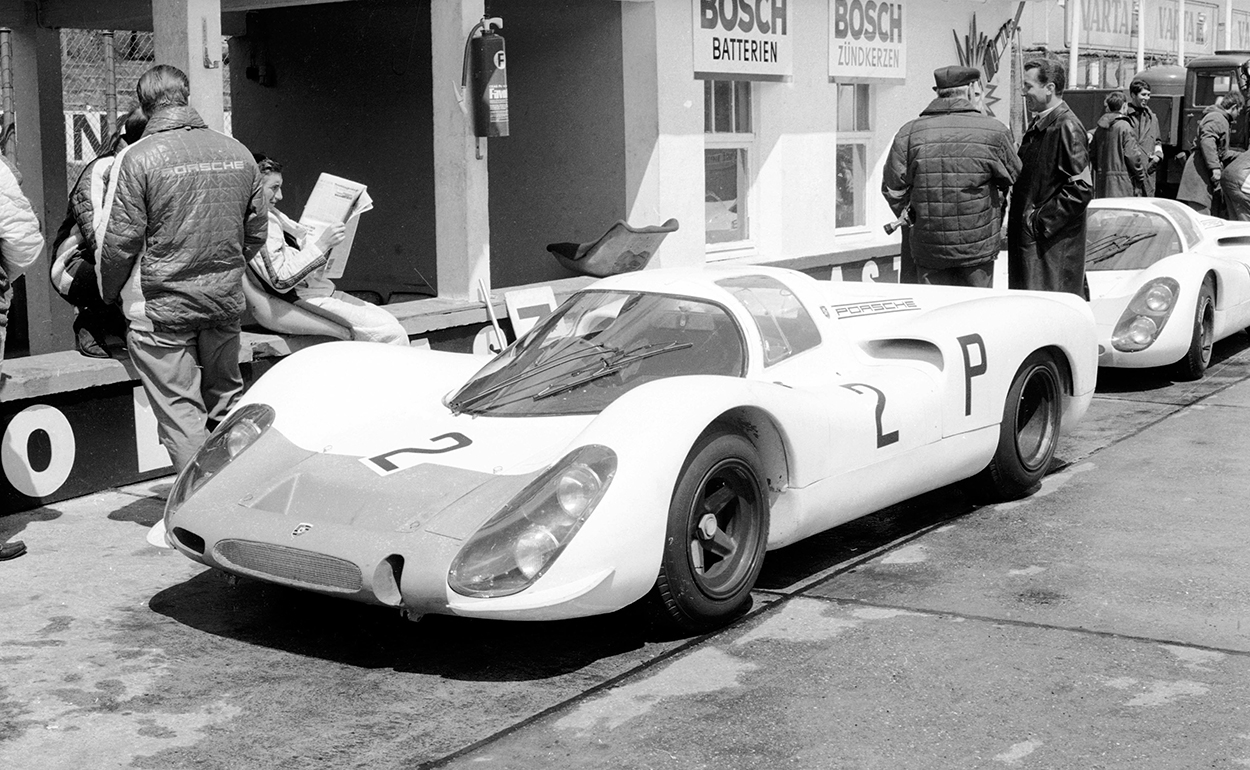
Présentée pour la saison 1968, la Porsche 908 est développée afin d'exploiter pleinement la nouvelle réglementation du Championnat du Monde des Marques limitant la cylindrée des prototypes Sport à trois litres. Succédant à la Porsche 907, elle inaugure un tout nouveau moteur huit cylindres à plat conçu spécifiquement pour cette catégorie et marque une étape majeure dans l'évolution des prototypes d'endurance de Stuttgart.
La nouvelle mécanique de 2997 cm³ repose sur une architecture flat-8 refroidie par air associée à quatre arbres à cames en tête et à une injection mécanique Bosch. Avec une puissance d'environ 340 chevaux à 8500 tr/min, elle offre un gain significatif par rapport aux précédents moteurs deux litres tout en conservant les qualités de fiabilité qui font la réputation de Porsche en compétition. Installé en position centrale arrière longitudinale, ce moteur est associé à une boîte manuelle à cinq rapports et à un châssis tubulaire particulièrement léger.
La 908 est conçue avant tout comme une voiture d'endurance capable de rivaliser avec les meilleures réalisations de Ferrari, Alfa Romeo et Matra. Sa structure multitubulaire est habillée d'une carrosserie profilée optimisée pour les longues lignes droites des grandes épreuves internationales. Malgré une puissance inférieure à certaines concurrentes de plus forte cylindrée, son poids remarquablement contenu de seulement 650 kg lui permet d'afficher des performances de tout premier ordre, avec une vitesse de pointe supérieure à 320 km/h dans certaines configurations.
Dès sa première saison, la 908 démontre son potentiel en remportant plusieurs succès majeurs et en permettant à Porsche de s'affirmer comme l'un des principaux prétendants aux titres mondiaux. Son développement constant donnera naissance à plusieurs variantes spécialisées, notamment les 908 LH à longue queue pour les circuits rapides ainsi que la 908/02 Spyder destinée aux tracés plus techniques.
La Porsche 908 joue également un rôle fondamental dans la préparation du programme 917. Les expériences acquises avec son moteur huit cylindres, son aérodynamique et son architecture de prototype moderne seront directement réutilisées lors du développement de la future 917. Pour cette raison, la 908 est aujourd'hui considérée comme l'un des prototypes les plus importants de l'histoire de Porsche, à la fois compétitive par elle-même et essentielle dans la conquête des grandes victoires d'endurance qui suivront.
.jpg)
.jpg)
.jpg)
.jpg)
.jpg)
.jpg)
.jpg)