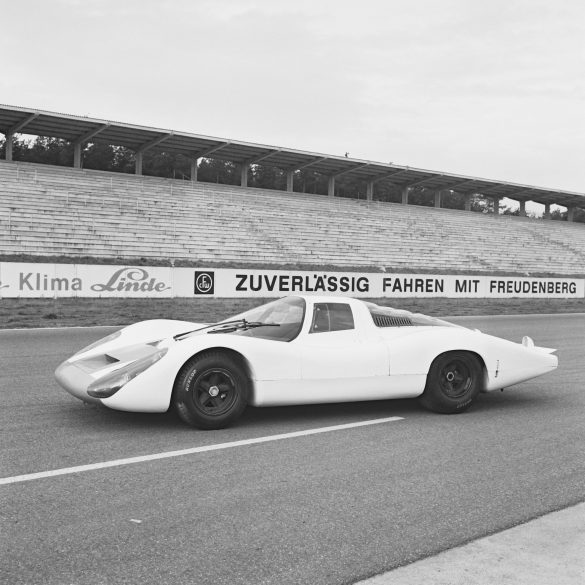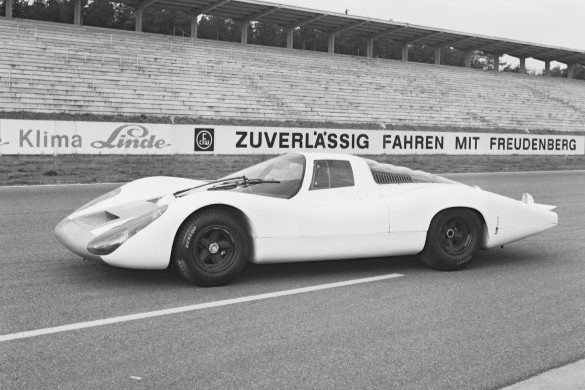
Présentée au cours de la saison 1967, la Porsche 907 représente l'évolution directe de la 910 et marque une étape déterminante dans l'ascension de Porsche vers les sommets de l'endurance internationale. Développée spécifiquement pour les circuits rapides du Championnat du Monde des Marques, elle se distingue par une aérodynamique profondément retravaillée, caractérisée par une carrosserie allongée et un poste de conduite avancé destinés à améliorer la stabilité et la vitesse maximale.
Les premières versions de la 907 sont équipées du traditionnel moteur Porsche six cylindres à plat de 1991 cm³. Alimenté par deux carburateurs triple corps et doté d'une distribution à simple arbre à cames en tête par rangée de cylindres, ce moteur développe environ 220 chevaux à 8000 tr/min. Grâce à une masse limitée à environ 700 kg et à une aérodynamique particulièrement soignée, la 907 dépasse les 300 km/h et devient l'une des voitures les plus rapides de sa catégorie.
Afin d'accroître encore sa compétitivité face à Ferrari et Chaparral, Porsche développe rapidement une seconde évolution utilisant un tout nouveau moteur huit cylindres à plat de 2195 cm³. Alimenté par injection mécanique et équipé de quatre arbres à cames en tête, ce moteur porte la puissance à environ 270 chevaux à 8600 tr/min. Cette version constitue une étape essentielle dans le développement du futur flat-8 trois litres qui équipera la Porsche 908.
La 907 se distingue également par sa remarquable efficacité aérodynamique. Les versions Langheck, ou « longue queue », sont spécialement conçues pour les circuits à très haute vitesse comme Le Mans, Monza ou Spa-Francorchamps. Leur carrosserie profilée réduit considérablement la traînée et leur permet d'atteindre des vitesses de pointe impressionnantes pour l'époque.
Les succès obtenus par la 907 au cours des saisons 1967 et 1968 permettent à Porsche de s'affirmer comme l'une des références de l'endurance mondiale. Plus qu'une simple évolution de la 910, elle constitue le véritable laboratoire de développement des futures 908 et 917. Son châssis, son aérodynamique et ses motorisations joueront un rôle fondamental dans les programmes qui conduiront Porsche à dominer les plus grandes courses d'endurance à la fin des années 1960 et au début des années 1970.
Aujourd'hui, la Porsche 907 est considérée comme le modèle charnière entre les premiers prototypes deux litres de la marque et les machines de légende qui suivront. Qu'elle soit équipée du moteur six cylindres ou du nouveau huit cylindres, elle demeure l'un des prototypes les plus importants de l'histoire sportive de Porsche.
.webp)
.webp)
.webp)
.webp)
.webp)