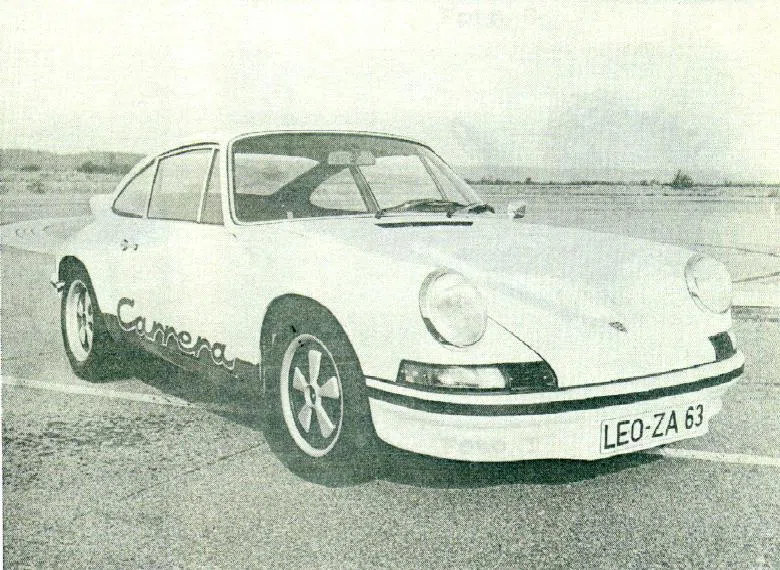
Homologuée sous la fiche FIA n°3053 pour la catégorie Grand Tourisme Groupe 3, la Porsche 911 Carrera RS 2.7 constitue l'une des versions les plus emblématiques de la première génération de 911. Développée afin de satisfaire aux exigences d'homologation en compétition, elle combine les qualités routières de la 911 de série avec une importante recherche d'allègement et de performances.
L'architecture de la Carrera RS repose sur une coque autoporteuse en acier associée à plusieurs éléments allégés. Le capot moteur ainsi que les pare-chocs avant et arrière utilisent des matériaux synthétiques afin de réduire le poids, tandis que l'habitacle reçoit des sièges baquets et un équipement simplifié orienté vers la performance. Le moteur conserve l'architecture traditionnelle Porsche à six cylindres opposés refroidis par air. Alimenté par injection mécanique Bosch, ce Flat-6 de 2687 cm³ développe 210 chevaux à 6300 tr/min et transmet sa puissance aux roues arrière par l'intermédiaire d'une boîte mécanique à cinq rapports entièrement synchronisés.
Le châssis fait appel à une suspension indépendante à barres de torsion sur les deux essieux. À l'avant, la voiture utilise des jambes de force avec bras transversaux, tandis que l'arrière repose sur des bras longitudinaux. L'ensemble est complété par des amortisseurs hydrauliques à double effet et des barres antiroulis destinées à améliorer la stabilité. Le freinage est assuré par quatre freins à disques ventilés commandés par un système hydraulique à double circuit.
Pour les clients souhaitant disposer d'une voiture plus proche de la compétition, Porsche proposait l'option M471 « Sportausstattung ». Cette option permettait de transformer une Carrera RS 2.7 standard en version Lightweight directement éligible aux compétitions du Groupe 3 sans modification mécanique majeure. Le moteur 2.7 litres de série était conservé, mais la voiture bénéficiait d'une importante réduction de poids grâce à un intérieur largement dépouillé, à l'adoption de sièges baquets spécifiques et à l'utilisation de vitrages amincis.
Les premiers exemplaires recevaient également plusieurs éléments de carrosserie en matériau synthétique afin de réduire encore la masse, avant qu'une partie de ces composants ne soit progressivement remplacée par des éléments métalliques au cours de la production. Un arceau de sécurité équipait la version Sport, mais contrairement aux futures Carrera RSR de Groupe 4, l'option M471 ne comprenait ni extincteur embarqué, ni coupe-circuit extérieur, ni modifications importantes du moteur ou de la transmission. L'objectif était avant tout de fournir une base légère et directement exploitable en compétition.
Grâce à cet équilibre entre légèreté, performances et polyvalence, la Carrera RS 2.7 s'impose rapidement comme l'une des 911 les plus performantes de son époque. Elle constitue également le point de départ des futures Carrera RSR de Groupe 4, dont les évolutions seront homologuées à partir de la même fiche FIA n°3053.
.webp)
.webp)
.webp)
.webp)
.webp)
.webp)
.webp)
.webp)
.webp)
.webp)
.webp)
.webp)
.webp)
.webp)
.webp)
.webp)
.webp)