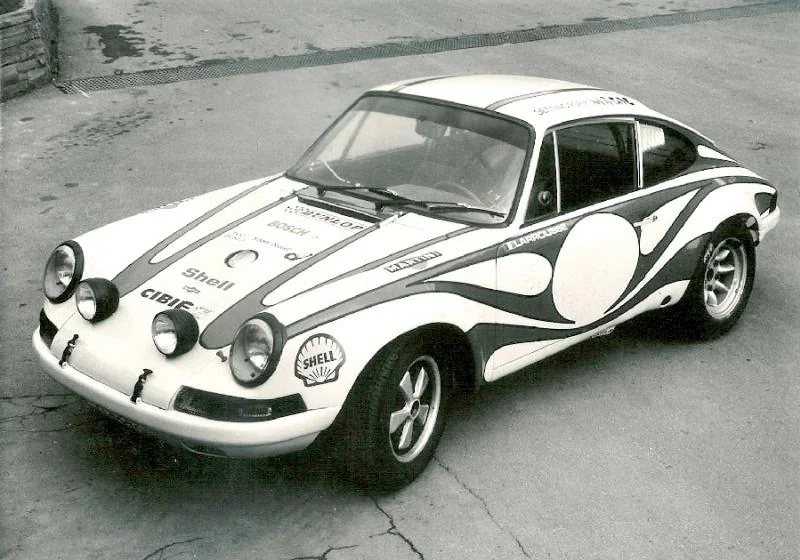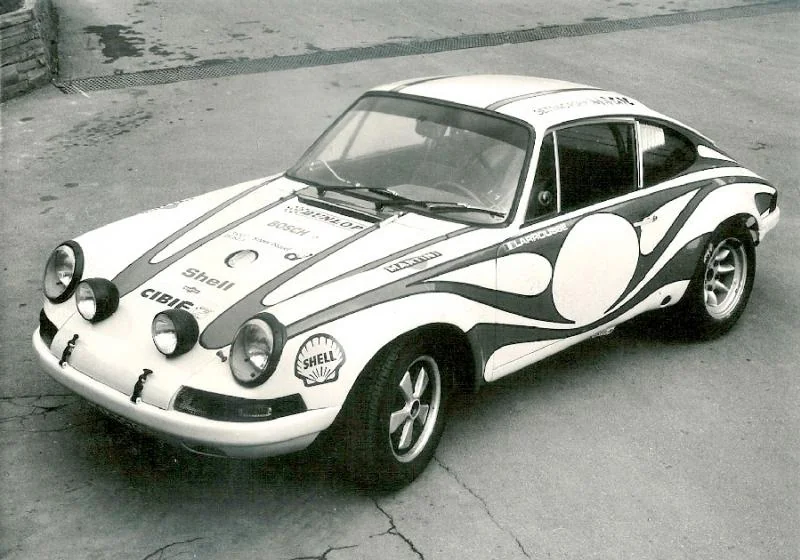
Développée spécifiquement pour la saison 1970, la Porsche 911 S-T constitue la première véritable déclinaison compétition de la 911 moderne exploitant pleinement les possibilités offertes par les extensions Groupe 4 de l'homologation FIA n°3025. Produite en très faible quantité, à seulement une vingtaine d'exemplaires durant sa première année d'existence, elle sert de laboratoire de développement à l'usine Porsche pour les futures Carrera RS et Carrera RSR. 【1-a3ff51】
Contrairement aux futures RS et RSR qui disposeront d'une identité propre, la 911 S-T est développée à partir de la 911 S homologuée en Groupe 3. Porsche propose alors l'option M471 « Sportausstattung », qui permet de transformer directement une 911 2.2L S standard en version Groupe 4. Cette spécification compétition regroupe l'essentiel des modifications homologuées par la FIA : ailes avant en polyester, portières en aluminium, lunette arrière et vitres latérales en Plexiglas, extensions d'ailes arrière, tableau de bord simplifié, suppression des dossiers de sièges arrière, arceau de sécurité en alliage léger de seulement 2,7 kg ainsi que l'élargissement des voies grâce à des entretoises de moyeux allant de 7 à 35 mm. 【1-a3ff51】
Pour atteindre le poids minimal de 930 kg, la voiture fait l'objet d'une véritable chasse aux kilogrammes superflus. La coque est allégée, plusieurs panneaux sont remplacés par des éléments plus légers et les pare-chocs peuvent être réalisés en matériau synthétique. Des réservoirs de sécurité de 80 ou 110 litres sont également homologués afin de répondre aux exigences des longues épreuves d'endurance. 【1-a3ff51】
Durant la saison 1970, l'offre mécanique repose exclusivement sur le Flat-6 de 2247 cm³. Deux versions sont proposées aux équipes clientes : le moteur Type 911/20 équipé de l'injection mécanique Bosch et le moteur Type 911/22 alimenté par carburateurs Weber. Grâce à sa légèreté et à son excellente motricité, la 911 S-T s'impose rapidement comme l'une des références de la catégorie Grand Tourisme internationale.
Pour la saison 1971, Porsche introduit une évolution de 2381 cm³ utilisant un alésage porté à 87,5 mm. Ce moteur, désigné Type 911/21 lorsqu'il est équipé de l'injection mécanique Bosch, demeure extrêmement rare et n'est fourni qu'à un nombre limité de clients privilégiés. Cette augmentation de cylindrée annonce directement les développements qui conduiront aux futures 2.5 S-R puis aux Carrera RS 2.7.
L'histoire de la 911 S-T est également liée à celle du préparateur français Louis Meznarie. En 1971, celui-ci développe un moteur expérimental de 2539 cm³ utilisant le nouveau vilebrequin à course de 70,4 mm qui sera ensuite repris sur les futures 2.5L S-R. Ce moteur est installé dans une 911 T engagée au Tour de France Automobile 1971 avec Jürgen Barth au volant. Inscrite dans la catégorie Groupe 6, la voiture ne parvient toutefois pas à rallier l'arrivée.
Par son niveau de préparation, sa légèreté exceptionnelle et son rôle de banc d'essai technique, la 911 S-T occupe aujourd'hui une place essentielle dans l'histoire sportive de Porsche. Elle constitue le chaînon direct entre les premières 911 de compétition de la fin des années 1960 et les mythiques Carrera RS et RSR qui assureront la domination de la marque en Grand Tourisme tout au long des années 1970.
.webp)
.webp)
.webp)
.webp)
.webp)
.webp)
.webp)
.webp)