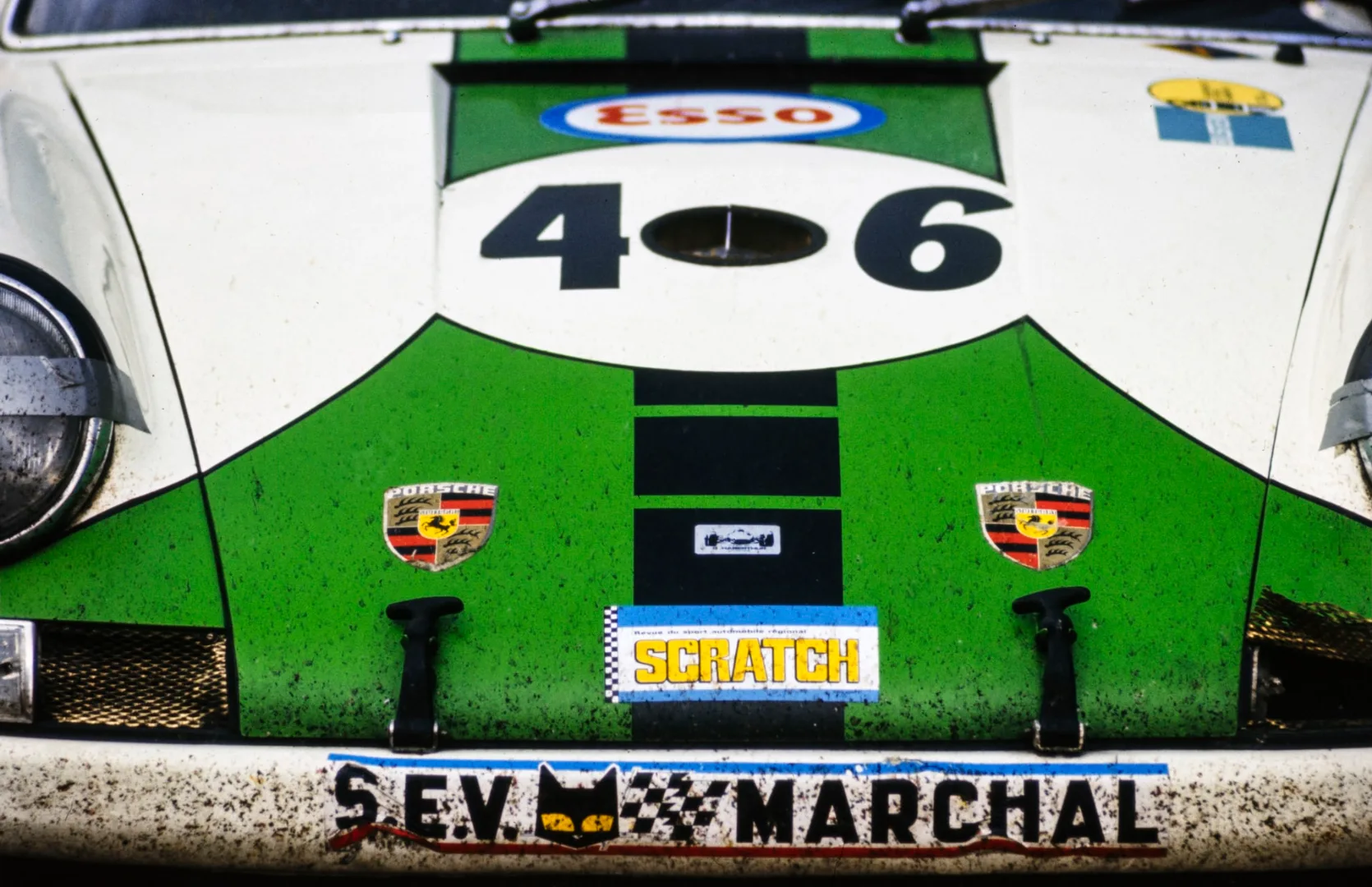
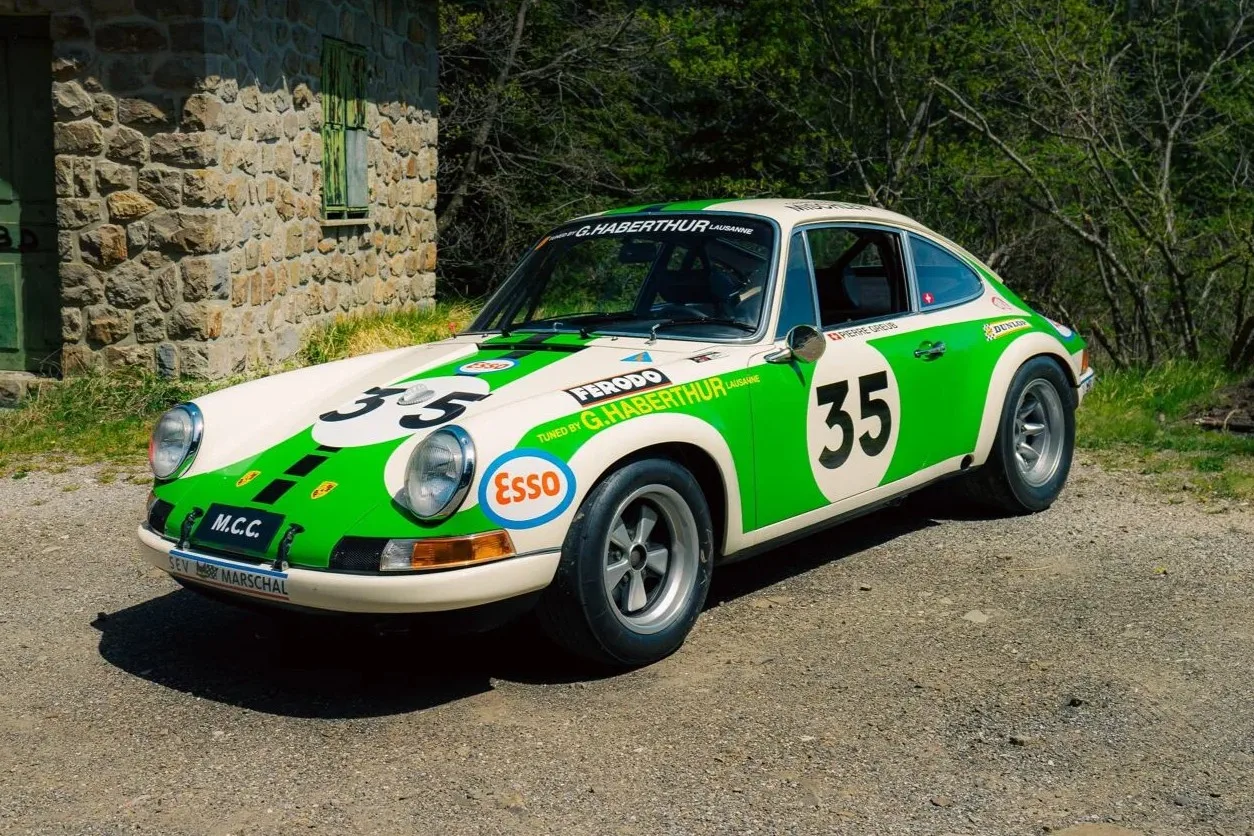
Construite en 1970 et enregistrée sous le numéro de châssis 911 030 1003, cette Porsche 911 2.3L S-T est un exemplaire de compétition assemblé à partir à l'usine par le département compétition de chez Porsche. Vêtue d'une teinte Light Ivory, elle est équipée de l'option M471 (Sportausstattung), un pack d'allègement radical permettant de limiter son poids à seulement 930 kilos. En porte-à-faux arrière se trouve un moteur 6 cylindres à plat de 2,3 litres (2381 cm³, type 911/20, numéro de bloc 6301377). Alimentée par des carburateurs, cette mécanique affûtée développe une puissance de 235 chevaux.
Livrée initialement en 1970 au célèbre pilote de l'usine Porsche Hans Herrmann, la voiture est acquise dès l'année suivante par le Porsche Club Romand en Suisse. Sous cette bannière, elle entame en 1971 une campagne européenne d'une intensité remarquable, principalement aux mains du pilote helvétique Pierre Greub. Le printemps 1971 est particulièrement chargé avec des participations aux essais et aux 3 Heures du Mans (épaulé par Sylvain Garant), suivies des 1000 Kilomètres de Spa (11e) et d'une superbe 8e place au classement général de la mythique Targa Florio, où Greub et Garant font briller le numéro 47. Après une apparition aux 1000 Kilomètres du Nürburgring, l'équipage se présente au départ des 24 Heures du Mans le 13 juin (n°35), mais l'épreuve s'achève prématurément sur une casse d'arbre à cames. La saison se poursuit sans relâche sur les circuits (Zeltweg, Paul Ricard où Jean-Claude Guérie arrache une victoire en National) et en courses de côte (Ollons-Villars, Azé Donzy le Pertuis).
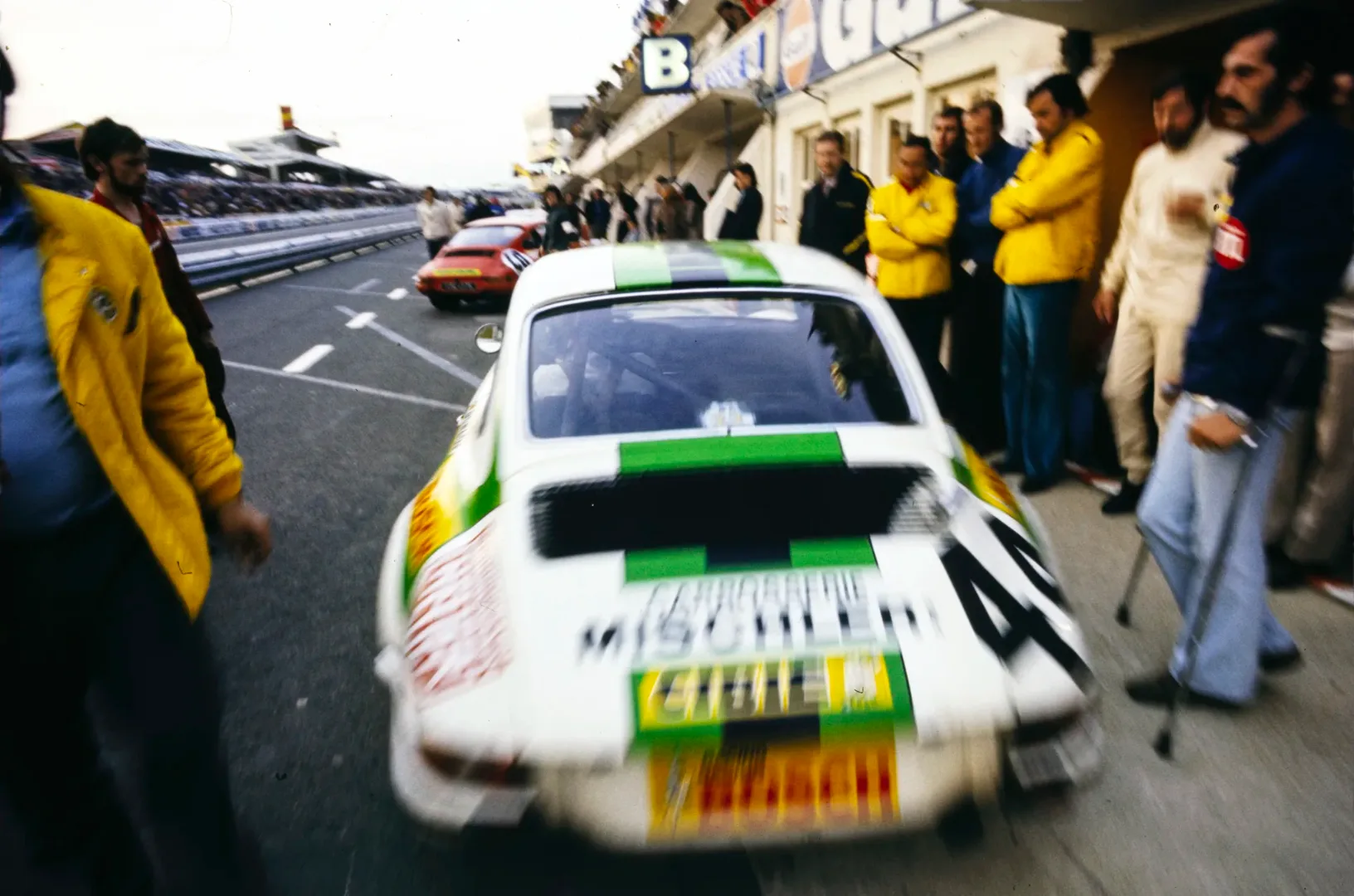
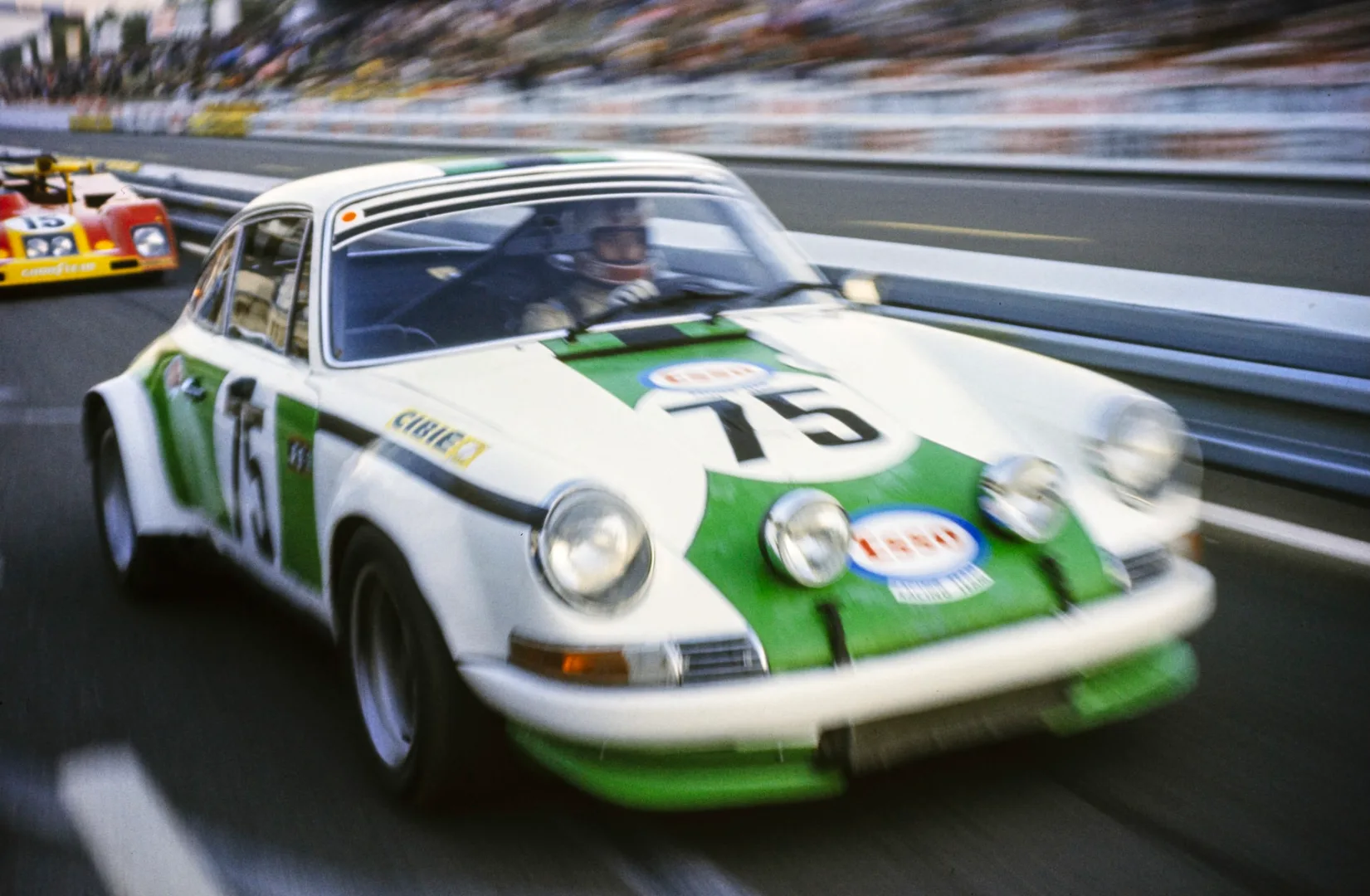
L'année 1972 s'inscrit dans la même frénésie compétitive, bien que les résultats soient plus contrastés face à une concurrence de plus en plus affûtée. Toujours fidèle au poste, Pierre Greub l'engage de nouveau aux essais et aux 4 Heures du Mans au printemps (abandon sur problème d'embrayage avec Jean-Claude Favre), puis multiplie les engagements en championnat GT européen (Nürburgring, Paris, Zandvoort, Hockenheim) et en courses de côte de la région (Chamrousse, Les Rangiers, ou encore La Faucille où Nelo Chelli signe un podium). En septembre, la 911 prend le départ du Tour de France Automobile mais est contrainte à l'abandon. La longue carrière sportive d'époque de la voiture s'achève en 1973, marquée par d'ultimes tentatives dans la Sarthe : après un abandon aux 4 Heures et une 21e place aux essais préliminaires avec Jean Égreteaud, le châssis, confié à Pierre Greub et Paul Keller (n°75), échoue finalement à se qualifier pour l'édition des 24 Heures du Mans de juin 1973.
Après avoir traversé les décennies, la voiture change de mains en 2022 avant de rejoindre en 2025 le giron du spécialiste MCC Monaco, puis d'être acquise par son propriétaire actuel, également basé en Principauté. Soucieux de préserver ce patrimoine roulant, le châssis a bénéficié d'une restauration intégrale menée de main de maître par les ateliers de Roock Sportsystem. Parfaitement remise en état, cette inlassable compétitrice a renoué avec le bitume en participant au Tour Auto 2023 (n°269, pilotée par Michel Speyer), puis a été exposée en 2024 lors du grand rassemblement britannique Boxengasse Megaphonics 24. Plus récemment, elle a de nouveau foulé les terres de ses anciens exploits en étant mise en lumière par MCC Monaco à l'occasion du Mans Classic 2025.
Built in 1970 and registered with chassis number 911 030 1003, this Porsche 911 2.3L S-T is a competition model assembled at the factory by Porsche’s racing department. Finished in Light Ivory, it features the M471 option (*Sportausstattung*)—a radical weight-reduction package that brings the car’s total weight down to just 930 kilograms. Housed in the rear is a 2.3-liter flat-six engine (2,381 cc, type 911/20, engine block number 6301377). Fed by carburetors, this highly tuned powerplant produces 235 horsepower.
Initially delivered in 1970 to renowned Porsche factory driver Hans Herrmann, the car was acquired the following year by the Porsche Club Romand in Switzerland. Under this banner, it embarked on an exceptionally intense European racing campaign in 1971, primarily driven by Swiss racer Pierre Greub. The spring of 1971 was particularly busy, with entries in the test sessions and the 3 Hours of Le Mans (with co-driver Sylvain Garant), followed by the 1,000 Kilometers of Spa (finishing 11th) and an impressive 8th-place overall finish at the legendary Targa Florio, where Greub and Garant piloted the car—bearing race number 47—to a strong result. After an appearance at the 1,000 Kilometers of the Nürburgring, the duo lined up for the 24 Hours of Le Mans on June 13 (car no. 35), but their race ended prematurely due to a broken camshaft. The season continued unabated on the circuits—including Zeltweg and Paul Ricard, where Jean-Claude Guérie secured a victory in the National category—as well as in hill climbs such as Ollons-Villars and Azé-Donzy-le-Pertuis.
The year 1972 followed this same frenetic competitive pace, though the results were more mixed as the competition grew increasingly sharp. Pierre Greub remained a constant presence, entering the car once again for the test sessions and the 4 Hours of Le Mans in the spring (where it retired due to a clutch issue, with Jean-Claude Favre at the wheel). He also campaigned the car extensively in the European GT Championship—at the Nürburgring, Paris, Zandvoort, and Hockenheim—and in regional hill climbs, including Chamrousse, Les Rangiers, and La Faucille, where Nelo Chelli achieved a podium finish. In September, the 911 took the start of the Tour de France Automobile but was forced to retire. The car’s long period of competitive racing came to an end in 1973, marked by final attempts at Le Mans: following a retirement in the 4 Hours and a 21st-place finish in the preliminary test sessions with Jean Égreteaud, the car—entered by Pierre Greub and Paul Keller (No. 75)—ultimately failed to qualify for the 24 Hours of Le Mans in June 1973.
After passing through the decades, the car changed hands in 2022 before joining the fold of the specialist firm MCC Monaco in 2025, and was subsequently acquired by its current owner, who is also based in the Principality. Committed to preserving this piece of automotive heritage, the car underwent a comprehensive, masterfully executed restoration by the workshops of Roock Sportsystem. Fully restored, this tireless competitor returned to the tarmac by taking part in the 2023 Tour Auto (no. 269, driven by Michel Speyer), and was subsequently exhibited in 2024 at the major British gathering, Boxengasse Megaphonics 24. More recently, it revisited the scene of its past triumphs, showcased by MCC Monaco at the 2025 Le Mans Classic.
.webp)
.webp)
.webp)
.webp)
.webp)
.webp)
.webp)
.webp)
.webp)
.webp)
.webp)
.webp)
.webp)
.webp)
.webp)
.webp)
.webp)
.webp)
.webp)
.webp)
.webp)